A choice you had to make
The professor gave everyone the same prompt: pick a decision you've had to make and build something around it. Most people did presentations. I made a game.
The decision I picked was the one that makes every game interesting — stay or cash out.Push your luck or take what you've got. Simple enough to explain in a sentence, deep enough to build a whole mechanic around.

Find the cube. Beat the clock. Know when to quit.
Players spawn into a procedurally generated world with 60 seconds to find a hidden chest. If the timer runs out — you lose everything.
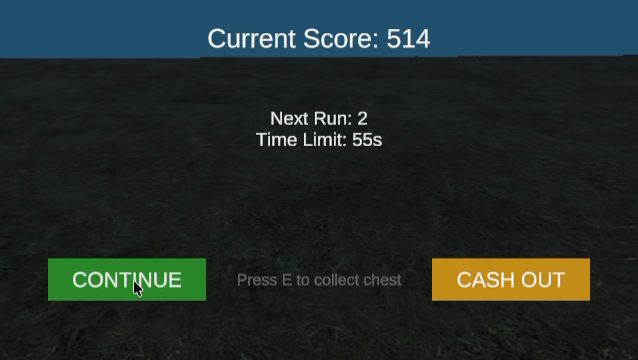
Find it, and you advance. Round two generates a completely new map with 5 fewer seconds on the clock. Round three, 5 fewer again. The maps get different but the pressure only goes one direction.
After each round, you get the choice: stay or cash out. Cash out and your winnings go to the menu screen. Stay and you risk it all for a bigger score.
One hour. Zero templates.
This wasn't about making the best game — it was about stretching what's possible. How much game can you ship in 60 minutes?
I used Claude Code with the Unity MCP — multiple agents working in parallel, handling different parts of the build simultaneously while I directed architecture and design. I wanted to see what happens when you hand the Unity MCP 3D models and a game idea.
Terrain generation, player controller, UI system, the risk-reward loop — all built from scratch. No starter kits, no templates, no boilerplate. Just an idea and agents.
Scope is the real boss fight
I had plans for powerups — speed boosts, time freezes, map reveals. Features that would have made the game legitimately good. But an hour is an hour.
The core loop shipped: procedural worlds, the timer, the decision. The powerups didn't. And that's the actual lesson — not that AI is fast, but that scope management matters more when you can build faster. Speed makes ambition dangerous.
When you can prototype anything in minutes, the bottleneck shifts from execution to judgment. Knowing what to cut is the skill.